New enrolled and registered nurse education standards
Education Programme Standards
The Council undertook further work on the education standards due to additional stakeholder feedback. The Council considered this alongside all stakeholder feedback, including strong support to maintain a high number of clinical learning hours.
The Council has confirmed changes to the clinical hours for both the enrolled and registered nurse scope. These changes are accompanied by strengthening the standards related to the quality of clinical learning.
The new requirements for clinical learning hours are a minimum of:
- 1,000 clinical hours for the registered nurse programme
- 700 clinical hours for the enrolled nurse programme.
Additional clinical learning hours will need to be available to support student success. These hours exclude simulation hours on the basis that education providers currently use simulation throughout the programmes to ensure students are appropriately prepared for their clinical learning experiences.
The Council will continue to specify minimum hours of clinical experience to ensure that students are adequately prepared and competent in the workforce.
It considers the revised standards will encourage and support innovative models of programme delivery, such as earn-as-you-learn models, marae-based education, and rural and remote delivery.
We expect to work with the education sector to transition to the new standards from February 2025.
What was this consultation about?
In 2022, the Nursing Council began a review of the Enrolled Nurse (EN) Scope of Practice which resulted in the development of a new and more flexible EN scope [available here], made public on 23 May 2023.
The new scope will be formally gazetted and come into effect late 2024, along with the newly developed education standards for programme providers and EN and RN standards for nursing competence when approved.
The EN education standards have been reviewed to align with the new EN scope of practice. Due to the broadening of the EN scope of practice, minor modifications to the RN education standards were required. This led to a restructure of both the EN and RN education standards into those that are generic and those that are specific to the programme being offered. We hope this will make accreditation and monitoring of programmes more straightforward for education providers.
The new standards are shaped to reflect the Council’s commitment to Te Tiriti o Waitangi and the role nurses play in improving health equity for Māori.
Given the rapidly changing nature of health care and service delivery, the new standards are broad and flexible to be future-focused in the education of nurses while at the same time supporting safe, quality care for the people of Aotearoa New Zealand.
How the standards were reviewed
We established an education standards review group with members drawn from the EN scope review design group, the New Zealand Nurses Organisation (NZNO) including the EN Section and Te Poari o Te Rūnanga o Aotearoa, educators, and employers. This group has developed the proposed changes to the education standards with concepts being tested through a broader sector reference group and wider sector engagement.
How was this consultation conducted?
Consultation for the enrolled nurse education standards (and amendments to registered nurse education standards) opened on 24 October 2023 and closed on 4 December 2023.
Consultation materials [available here] included a consultation document with the proposed changes and key consultation questions, an online questionnaire, and a question template for written submissions. The project team also engaged in additional targeted consultation meetings.
What did we hear from the consultation?
The Council received 102 submissions: 80 of these were individual survey submissions and 22 were written submissions. Of the 80 survey responses, 10 respondents (12.5%) identified as Māori, four (5%) identified as Pacific, and five (6%) identified as having a disability. Twenty submitters (25%) noted that they worked in either a Māori or Pacific health service provider.
A summary analysis of the consultation can be downloaded [available here], and those submitters who agreed to have their written responses made public are included at the end of this document.
Summary of responses
Overall, there was positive support from across the sector to the proposed changes to the educations standards structure. Of the 65 responses to this survey question, 57 (88%) agreed and eight (12%) disagreed.
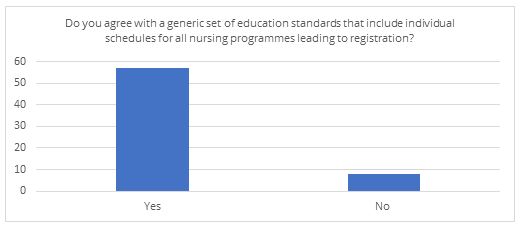
Key points:
- The response was especially strong in respect of the new education standards recognising the importance of Te Tiriti o Waitangi principles and partnership obligations.
- There was considerable support for a formal relationship with an institution offering a Bachelor of Nursing to deliver the New Zealand Diploma of Enrolled Nursing programme. This has been moved from Standard 2.2 to Standard 3.1 as it is more appropriately positioned under academic governance, leadership, and partnership.
- There was support for the proposed change to enrolled nurse ākonga/students completing a minimum of 700 hours of quality clinical learning, and 900 hours if required, with recognition the existing standard requires 900 clinical experience hours with simulation comprising no more than 200 hours.
- There was mixed feedback to reducing registered nurse ākonga/students’ quality clinical hours to a minimum of 1,000 clinical hours, and 1,400 hours if required, from the existing 1,100 hours of quality clinical learning, and 1,500 hours if required.
- There were recommendations that the Council completes the EN and RN competencies review, and review of the kawa whakaruruhau and cultural safety guidelines, to support the new education standards.
- There were considerable comments related to education pathways, recognition of prior learning, and the development of bridging programmes for transition from EN to RN.
What has the Council decided?
The Council has considered all the feedback and agreed to approve the new enrolled and registered nurse education standards with minor amendments following overall support from respondents.
The Council has confirmed changes to the clinical hours for both the enrolled and registered nurse scope. These changes are accompanied by strengthening the standards related to the quality of clinical learning.
The new requirements for clinical learning hours are a minimum of:
- 1,000 clinical hours for the registered nurse programme
- 700 clinical hours for the enrolled nurse programme
Accreditation against the new standards will begin early 2025. Any new providers of nursing programmes seeking accreditation will be expected to meet the new standards.
We will work alongside the sector to implement these changes over the course of the next two years. We recognise that the education sector will need some time to work through the required industry processes with the changes to the EN Diploma. We will build this into our transition and implementation programme.
These timeframes are estimates at this stage, and we will provide plenty of advance notice to all affected organisations before changes are implemented.
Written submissions
Below are the written submissions we received for this consultation and which we have been given permission to publish:
Anonymous
C Campbell
CCHV Nursing Leadership
College of Emergency Nurses, NZNO
Health and Disability Commissioner
Health Informatic NZ Nursing and Midwifery
Joint Feedback Te Whatu Ora Te Aka Whai Ora
Manukau Institute of Technology
Mental Health Nurses Section, NZNO
National EN Section, NZNO
New Zealand Nurses Organisation
NZOHNA
Nursing Education Tertiary Sector
Nursing Midwifery Board Australia
Office Chief Nurse Manatū Hauora
Otago Polytechnic Te Pūkenga
Rohe 4 Te Pūkenga
Te Whatu Ora Bay of Plenty
Te Whatu Ora PPD Counties Manukau
Te Whatu Ora Taranaki DONs
Te Whatu Ora Waikato
Te Whatu Ora Waitaha
UP Education
Whitireia Te Pūkenga
Yoobee Colleges Ltd
Yoobee Healthcare Academy External Advisory Committee